
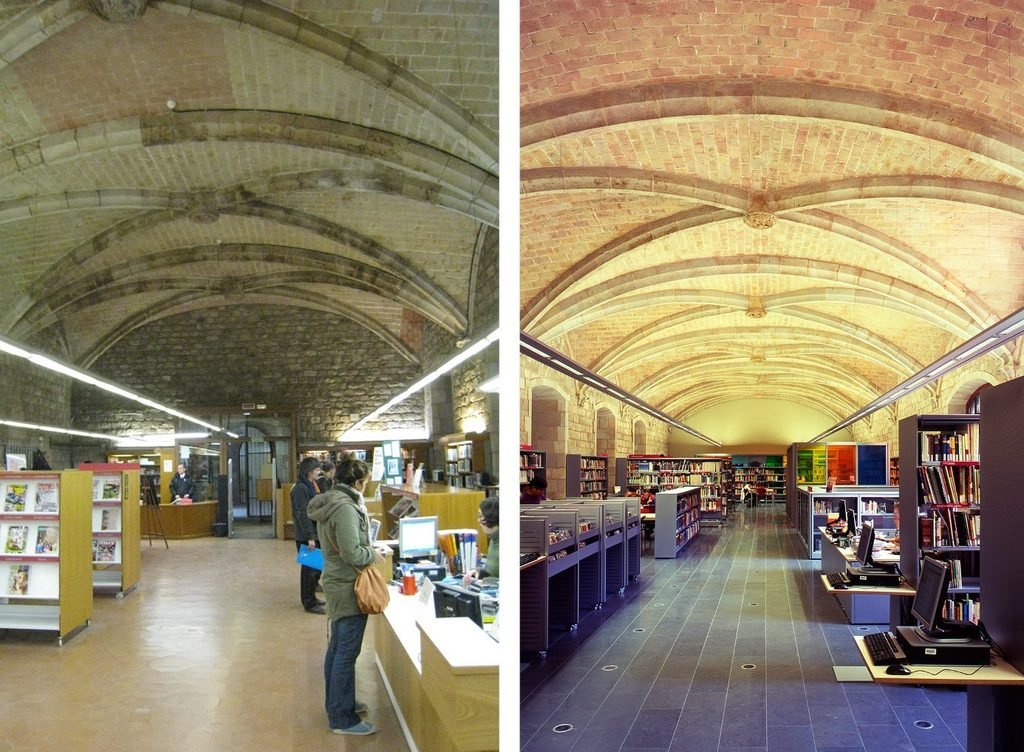
The Sant Pau Library won an innovation prize. Not for its design. For solving a problem no one else had thought to solve.
In 2008, the Barcelona City Council urgently needed to activate a backlog of projects. The brief was straightforward on paper: climate control, lighting upgrades, and general improvements to a National Historic Monument, in under three weeks.
Every other firm invited to tender was an engineering consultancy. We were the only architects. When we asked why, the client said the building deserved a particular sensitivity, and that our track record suggested we might bring it.
That framing changed everything.
The constraint was absolute: walls and ceilings were untouchable. The solution had to come from the floor.
What started as a conventional fan-coil proposal opened a different conversation. Two specialists we were working with were developing something more ambitious: a reticular system combining radiant conditioning with micro-ventilation, designed for concrete-filled floors. Never implemented anywhere. The missing piece was adapting it for dry-laid assembly: no screed, no irreversible intervention. That became my contribution. We aligned visions, they developed the system, and I took on the responsibility of integrating it with the contractor and client, which meant redefining the scope of the commission and securing approval for something well beyond the original brief. All of it within the budget assigned to a far more limited intervention, something impossible under conventional procurement.
Getting there required dissolving the boundaries between roles. The contractor became a collaborator. We opened our books. They opened theirs. A conventional commission became an informal Integrated Project Delivery: shared information, shared risk.
The client’s condition was unambiguous: the risk is yours entirely. We accepted it. In Spain, architects carry significant liability. In this case, it was the only way forward.
The result was the 2012 Catalan Prize for Innovation in Construction. More importantly, a building that works, quietly, invisibly, without compromising a single surface that took a century to build.
The lesson has stayed with me: the architect’s most valuable role is not to impose a vision. It’s to articulate a solution that everyone else can build. #ArchitecturalDesign #HeritageArchitecture #IPD
#ArchitecturalDesign #HeritageArchitecture #IPD
Deja un comentario